

Multi-Purpose Communion Tables: Smart Solutions for Small Spaces

Small congregations often need to carry a full ministry load in buildings that were never designed to carry it. It’s becoming more common every day. The same room that hosts Sunday morning worship becomes something else during the week. So every piece of furniture in that building needs to earn its space to avoid clutter. Pieces that serve only one purpose become liabilities in a space where every square foot matters. The Communion table sits right at the intersection of this challenge between visual focus and occupying platform space that may need to be reclaimed for other purposes between services. Multi-purpose design addresses that tension. Here’s how it helps. The real space problem in small sanctuaries When the platform has to do everything A congregation worshipping in a sanctuary under 3,000 square feet faces platform constraints that will never be an issue with larger sanctuaries. The platform is there to serve as a preaching space, but it needs to do other things too. A large, fixed Communion table consuming the center of that platform is going to create genuine operational challenges every time the room needs to be reconfigured. Small church furniture that is easily moved gives your facilities team the maximum flexibility a multi-use building needs without requiring a second, lesser table for non-worship functions. The same table that holds Communion elements on Sunday morning rolls to a storage position on Saturday afternoon without a second thought. The perception problem worth addressing Some congregations resist multi-functional furniture for their small altar space. The main reason? They feel it to be a compromise of the table’s sacred function. That concern reflects genuine seriousness, and it deserves a serious response. The table’s sanctity comes from what it holds and what it represents, not from its physical weight or immobility. A Communion table that serves its congregation faithfully across a full week of ministry activity, then holds the bread and cup on Sunday morning with the same dignity as a fixed piece, honors its purpose. Small church furniture carefully chosen does not need an apology; just good design and honest use. What multi-purpose actually looks like in practice Casters and mobility A Communion table mounted on locking casters rolls into position for Sunday morning service and locks securely during worship. After the benediction, it rolls to a storage position along a wall or into an adjacent room. This way, you reclaim the platform for what comes next. For a small sanctuary setup, the mobility afforded by a caster-mounted table changes what the building can accomplish throughout the week. Smaller dimensions and tablecloths Smaller does not mean less important or less impactful. Measure the space you have to work with -certainty about the space allows for smart Communion station arrangements. Table covers do a magnificent job dressing up the table for other uses between services. Space constraints don’t limit Presence. These ideas for the Lord’s Table offer the right engineering requirements, but always make sure to evaluate your sanctuary before purchasing. Materials and finish for multi-purpose tables Durability under movement A Communion table that moves regularly is going to accumulate wear at its contact points. Small church furniture specified for multi-purpose use needs heavier finish protection at those contact points and hardware built for repeated mechanical cycling rather than one-time installation. A solid wood altar table on a multi-purpose base is able to handle this wear cycle better than other alternatives. Church table cost comparison for multi-purpose options A church table cost comparison between standard fixed Communion tables and multi-purpose alternatives typically shows a modest premium for the mobility hardware. You will need to evaluate that premium against the cost of a second table for non-worship functions, along with the cost of a storage solution for a fixed table during room reconfigurations. The church table cost comparison often resolves in favor of multi-purpose options when those factors enter the calculation honestly. Small sanctuary setup design principles Keep the table visible A multi-purpose table that rolls to a secondary position during certain services or events needs to have a clear primary deployment position that your congregation recognizes immediately as the Communion table’s home. Small church altar placement in a small sanctuary needs to prioritize the congregation’s sightline from every seat position. High-end church furniture is not off the table for small congregations Some smaller congregations might think that quality church furniture is only for larger ministry budgets, and that assumption costs small churches real money. High-end church furniture built to commercial specifications carries material quality and finish standards that serve a small congregation’s small sanctuary setup faithfully, as they serve a large one. A small church altar built from quality materials and finished with commercial standards is going to serve your congregation faithfully for a generation. A shortlist worth considering Maple Communion Table with Walnut Stain This one from AllCommunion.com offers maple hardwood construction. The walnut stain brings warmth and depth that coordinates naturally with a wide range of existing sanctuary furniture. “In Remembrance of Me” engraved across the front establishes the table’s theological identity visually before the service begins. For a small sanctuary setup that needs a quality hardwood piece, this one ticks all the right boxes for you. Some assembly is needed to keep the shipping cost manageable for congregations working with a modest small church furniture budget. Oak Finish Communion Table The arched design detail on this table’s front apron gives it a traditional character that is perfect for formal or semi-formal sanctuary environments. The oak finish coordinates with the broadest range of existing wood tones in sanctuary furniture. This also has the inscription on the front. For a small church altar position in a traditional or transitional sanctuary, this table anchors the platform with the visual weight a Communion table needs without overwhelming the compact space. Acrylic Communion Table with Last Supper Image Also from AllCommunion.com. This contemporary table is a half inch acrylic construction at 30 inches in height, giving this table a visual character that is not
DIY Communion Table vs Buying Ready-Made: Pros & Cons
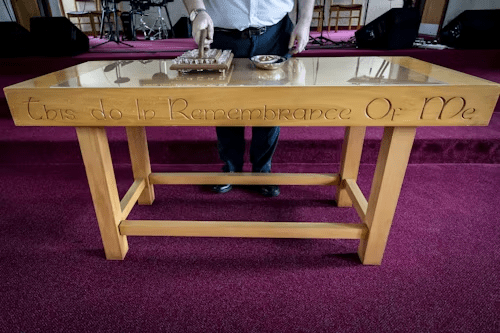
Every church is eventually going to face this decision. The communion table sits at the front, visible every week, carrying meaning far beyond wood and design. It reminds the church of Christ’s finished work and the unity shared in Him. So the question becomes really practical. Should a church build its own table or get one that’s already made? This conversation around DIY Communion table pros and cons goes on much deeper than cost. It touches identity and how a church chooses to present something that holds spiritual weight. Why the Communion table matters in the first place The Lord’s Table reflects simplicity in many churches. It points to what Christ has already done. At the same time, it still shapes the room. It becomes part of the visual story every week and quietly forms a focal point that people return to again and again. These are the reasons that the decision between building and buying will need careful consideration. The case for a DIY Communion table Some churches choose to build their own table. This often begins with a desire to steward resources wisely or to create something that reflects the church’s character. A DIY Communion table allows full control over the design. You get to decide the size and the wood type. You even get to decide the inscriptions. That freedom helps the table match the rest of the space without compromise. Many churches also involve members in the process. Skilled volunteers step in, and the project becomes part of the life of the church. That kind of work connects people in a meaningful way. This approach often fits well within broader DIY church furniture efforts, especially if there are professional carpenters and wood-workers in the congregation. Strengths of DIY The first advantage: This shows up in the cost. Materials usually cost less than finished furniture, especially when volunteers provide labor. The second advantage: It comes in the form of flexibility. A church is able to adjust dimensions to fit its exact layout. This matters in spaces where standard sizes do not work well. The third advantage: This involves identity. A handmade table often carries a story. People remember who built it and why. These benefits shape one side of the DIY Communion table pros/cons discussion. Challenges of DIY Building furniture needs skill; the final result will lack stability or finish quality without experience. Time is also another important factor here. A project can stretch longer than expected. This is especially true when volunteers are balancing other responsibilities. Durability raises another concern here. Poor construction leads to structural issues over time. Even the smallest details matter: uneven legs or rough edges can distract from the purpose of the table. These challenges often appear in DIY church furniture projects when planning falls short. The case for buying ready-made Some churches choose to buy a finished Communion table as this path removes uncertainty and often brings immediate results. Suppliers like AllCommunion.com offer tables with maximum durability in mind. Many of these tables use hardwood like oak or maple and apply finishes that resist wear. This approach provides consistency. The table comes ready to use with a proper finish and structural strength already in place. Strengths of ready-made tables The first advantage: It shows up in reliability. A professionally built table stands firm and holds up quite well under years of use. The second advantage: It involves design quality. You get clean lines and smooth finishes that help the table sit naturally within the space. The third benefit: It comes from time. Churches can place the table immediately without waiting for construction to finish. These points strengthen the buying side of the Communion table pros/cons discussion. Challenges of ready-made tables Cost remains the biggest barrier here because high-quality tables will need a larger upfront investment. Customization might also feel limited. While many suppliers will offer you options, you might not find an exact match for your space or vision. Shipping and delivery timelines also can delay installation. Still, many churches accept these trade-offs because of the consistency they receive. Design and aesthetic impact The table needs to work with the room and not feel out of place or disconnected from the rest of the space. A thoughtful altar table styling approach is going to help keep things aligned. Handmade tables sometimes are going to struggle here if the material or finishes do not match the existing elements. On the other hand, a well-built DIY Communion table can blend perfectly when planned and executed well. A strong visual connection supports the entire space and keeps the attention centered. Long term perspective Churches do not replace Communion tables often and the decision is going to last you for many years. A well built table (handmade or purchased) needs to continue to serve without constant repair. Durability becomes the key factor here. Ready-made tables often hold an advantage thanks to professional construction methods. Still, a carefully built DIY Communion table can reach the same level when skilled hands guide the process. Long-term thinking is going to help your church avoid repeated expenses and unnecessary replacements. Bringing the decision together The choice between buying and building depends on your church’s situation. A church with skilled members and time may find value in creating a DIY Communion table. The process itself can strengthen the community, and also produce something very meaningful. A church that needs consistency and speed will benefit from buying a finished table, as the result arrives ready and dependable. Both of these paths hold value. The key lies in honest evaluation. The full picture of communion table pros and cons becomes clear when churches consider skill and budget, along with long term use. Final thought The Communion table points to Christ and the unity of His people. It needs to serve faithfully. A well-chosen table supports that purpose without distraction. The table becomes a part of the worship space in a quiet, steady way. It does it through thoughtful altar table