
Every church is eventually going to face this decision. The communion table sits at the front, visible every week, carrying meaning far beyond wood and design. It reminds the church of Christ’s finished work and the unity shared in Him.
So the question becomes really practical. Should a church build its own table or get one that’s already made?
This conversation around DIY Communion table pros and cons goes on much deeper than cost. It touches identity and how a church chooses to present something that holds spiritual weight.
Why the Communion table matters in the first place
The Lord’s Table reflects simplicity in many churches. It points to what Christ has already done. At the same time, it still shapes the room. It becomes part of the visual story every week and quietly forms a focal point that people return to again and again.
These are the reasons that the decision between building and buying will need careful consideration.
The case for a DIY Communion table
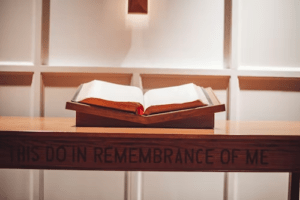
Some churches choose to build their own table. This often begins with a desire to steward resources wisely or to create something that reflects the church’s character.
A DIY Communion table allows full control over the design. You get to decide the size and the wood type. You even get to decide the inscriptions. That freedom helps the table match the rest of the space without compromise.
Many churches also involve members in the process. Skilled volunteers step in, and the project becomes part of the life of the church. That kind of work connects people in a meaningful way. This approach often fits well within broader DIY church furniture efforts, especially if there are professional carpenters and wood-workers in the congregation.
Strengths of DIY
- The first advantage: This shows up in the cost. Materials usually cost less than finished furniture, especially when volunteers provide labor.
- The second advantage: It comes in the form of flexibility. A church is able to adjust dimensions to fit its exact layout. This matters in spaces where standard sizes do not work well.
- The third advantage: This involves identity. A handmade table often carries a story. People remember who built it and why.
These benefits shape one side of the DIY Communion table pros/cons discussion.
Challenges of DIY
Building furniture needs skill; the final result will lack stability or finish quality without experience. Time is also another important factor here. A project can stretch longer than expected. This is especially true when volunteers are balancing other responsibilities.
Durability raises another concern here. Poor construction leads to structural issues over time. Even the smallest details matter: uneven legs or rough edges can distract from the purpose of the table.
These challenges often appear in DIY church furniture projects when planning falls short.
The case for buying ready-made
Some churches choose to buy a finished Communion table as this path removes uncertainty and often brings immediate results.
Suppliers like AllCommunion.com offer tables with maximum durability in mind. Many of these tables use hardwood like oak or maple and apply finishes that resist wear.
This approach provides consistency. The table comes ready to use with a proper finish and structural strength already in place.
Strengths of ready-made tables
- The first advantage: It shows up in reliability. A professionally built table stands firm and holds up quite well under years of use.
- The second advantage: It involves design quality. You get clean lines and smooth finishes that help the table sit naturally within the space.
- The third benefit: It comes from time. Churches can place the table immediately without waiting for construction to finish.
These points strengthen the buying side of the Communion table pros/cons discussion.
Challenges of ready-made tables
Cost remains the biggest barrier here because high-quality tables will need a larger upfront investment. Customization might also feel limited. While many suppliers will offer you options, you might not find an exact match for your space or vision.
Shipping and delivery timelines also can delay installation. Still, many churches accept these trade-offs because of the consistency they receive.

Design and aesthetic impact
The table needs to work with the room and not feel out of place or disconnected from the rest of the space. A thoughtful altar table styling approach is going to help keep things aligned.
Handmade tables sometimes are going to struggle here if the material or finishes do not match the existing elements. On the other hand, a well-built DIY Communion table can blend perfectly when planned and executed well. A strong visual connection supports the entire space and keeps the attention centered.
Long term perspective
Churches do not replace Communion tables often and the decision is going to last you for many years. A well built table (handmade or purchased) needs to continue to serve without constant repair.
Durability becomes the key factor here. Ready-made tables often hold an advantage thanks to professional construction methods.
Still, a carefully built DIY Communion table can reach the same level when skilled hands guide the process.
Long-term thinking is going to help your church avoid repeated expenses and unnecessary replacements.
Bringing the decision together
The choice between buying and building depends on your church’s situation.
A church with skilled members and time may find value in creating a DIY Communion table. The process itself can strengthen the community, and also produce something very meaningful.
A church that needs consistency and speed will benefit from buying a finished table, as the result arrives ready and dependable. Both of these paths hold value. The key lies in honest evaluation.
The full picture of communion table pros and cons becomes clear when churches consider skill and budget, along with long term use.
Final thought
The Communion table points to Christ and the unity of His people. It needs to serve faithfully. A well-chosen table supports that purpose without distraction. The table becomes a part of the worship space in a quiet, steady way. It does it through thoughtful altar table styling and careful planning.
In the end, the decision rests on stewardship. Use what God has placed in your hands and build something that serves the church well. We here at AllCommunion carry an excellent line of Communion tables for your consideration.