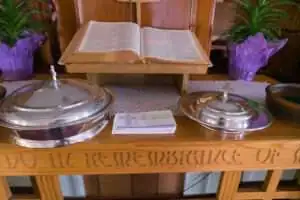

The wood from which your Communion table is constructed determines everything in your ownership that follows. It determines whether it still looks dignified twenty years from now or requires replacement in five. Most congregations spend more time choosing the table’s appearance than its material, which is exactly the wrong order of priorities.
A Communion table built from the right wood type serves your congregation for generations. Once built from the wrong material, or even the correct material but dried and finished poorly is going to deteriorate faster than anyone expected and costs the church more in the long run than a quality option would have.
Here is an honest look from allcommunion.com at the wood types that actually earn their place in a Communion table.
What makes wood suitable for a Communion table
Hardness and density
Wood hardness determines how well a particular wood resists denting and surface compression that weekly ministry use creates. The Janka hardness scale measures this. Higher Janka ratings mean harder wood. For a modern altar place that sees weekly use across decades, hardness matters.
Softwoods like pine or cedar score low on the Janka scale. So they will dent under normal use.
Hardwoods like oak or maple resist that type of damage and maintain their surface integrity across the long ministry lifespan a Communion table requires.
Stability and moisture exposure
All wood moves with seasonal humidity changes. Wood types differ significantly in how much they move and how predictably they do so. A stable wood is going to be much better at holding its joints and maintaining its finish over years of seasonal cycling.
Communion table wood specified for stability handles heating and cooling cycles much better in most sanctuaries without any structural consequence.
Oak
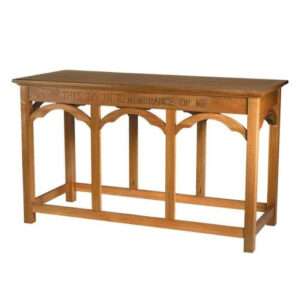
Red oak and white oak
Oak dominates church furniture production, and with good reason. Oak is hard and is widely available. Plus, it also stains beautifully. Oak has an established track record in ecclesiastical settings that spans centuries. For altar styles, oak performs equally well across the full range.
Red oak has a slightly more open grain structure than white oak. This means it accepts wood-stain faster and displays a more dramatic grain figure under finish. White oak has a tighter grain and slightly cooler tone that suits contemporary altar styles well.
White oak also carries natural tannins that make it resistant to moisture and biological deterioration. White oak in either a clear or lightly tinted finish represents the most balanced combination of performance and appearance available at its price point for a custom Communion table built to last across a generation of ministry.
Maple
Hard maple’s performance characteristics
Maple wood table construction offers the highest hardness rating of any commonly available domestic species used in furniture. It is harder than oak or cherry. It’s even harder than walnut. Hard maple is able to resist surface damage exceptionally well. This makes it ideal for a modern altar in a high-traffic environment.
Maple’s tight, consistent grain structure offers a smooth surface under finish, well-suited to contemporary and transitional altar styles where clean, uninterrupted surfaces carry the design.
Maple wood accepts paint and opaque finishes beautifully as well, thus it becomes the right substrate for custom Communion table pieces designed to be painted or finished in a color rather than a traditional wood strain.
The tradeoff is that hard maple resists penetrating stains. This can lead to blotchy and uneven results sometimes.
Cherry
Character that improves with age
Cherry holds a very specific place in American furniture tradition. A tradition that extends naturally into church settings. Fresh cherry wood runs a pale pinkish-brown. It darkens to a rich reddish-brown through a natural oxidation process. A cherry Communion table develops a patina over the years of use that makes it look more valuable.
Communion table wood in cherry suits traditional and transitional sanctuaries. The tradeoff is, because cherry wood is softer than maple and slightly softer than oak, cherry accumulates surface marks more readily in high-contact areas.
Walnut
Dark tone and visual authority
Walnut has the darkest natural tone of any commonly used domestic hardwood. It is that darkness that gives a walnut modern altar a visual authority. Lighter-toned woods are not able to replicate this. A walnut Communion table creates a focal point that draws the eyes deliberately in a contemporary sanctuary with light walls.
Durable wood types for Communion tables will rarely include walnut at the top of the hardness chart. But walnut’s dimensional stability and its natural oils make it resistant to environmental stress.
Altar style in contemporary and transitional church design increasingly features walnut as the statement material. For a congregation investing in a Communion table that anchors a carefully designed platform environment, walnut justifies its premium price point through both performance and visual contribution.
Species to approach with caution
Pine and softwood alternatives
You find pine in Communion table production sometimes because it is inexpensive. Plus, you find this type of wood everywhere. It has got all the good qualities you need, but its softness is something to look out for. Under weekly ministry use, it dents at contact points and begins to show wear in high-contact areas faster.
For a modern altar piece built to serve durably across a decade or more, pine is the wrong choice, regardless of the price advantage you are getting.
Exotic hardwoods
Exotic wood types appear occasionally in altar styles targeting a distinctive visual statement. Some perform well. Others bring challenges. More practically, exotic types can be very difficult to match for repairs. This is a significant consideration for a Communion table that might need a matching lectern or flanking furniture added later.

We here at AllCommunion.com knows that your Communion table’s wood type is a decision made once and lived with for a generation. You will need to choose a wood matched honestly to your sanctuary’s aesthetic. A Communion table built from the right wood and maintained with basic care serves your congregation’s worship for decades. Exactly the kind of stewardship that honors the purpose that the table was built to serve. AllCommunion has an excellent selection of Communion tables that will stand the test of time in your sanctuary.