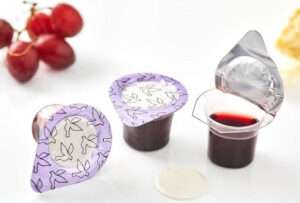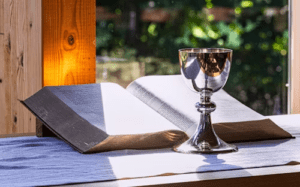

That table at the front of your sanctuary carries weight every Sunday. Not just the bread and the cup, but the moment itself. So when your church starts talking about replacing or upgrading it, the conversation usually lands on two of the most common options out there. Wood or acrylic.
Both show up very consistently in church stage furniture trends, and both have real advocates.
However, each one is here to serve different rooms and different visions for what that space needs to feel like. Here is what actually separates them.

The case for wood
Wood has been the default choice for centuries, and not by accident. There is a reason elders and pastors instinctively trust it. A solid wood altar table carries a sense of permanence. It does not need explanation. It communicates the moment someone walks through the doors that this space holds spiritual significance.
Solid hardwoods like oak and maple are able to hold up over decades. They don’t scratch the same way as softer materials do, and any surface damage that does happen can often be repaired and refinished. You will not need to replace them entirely; that matters for churches thinking long-term.
If your sanctuary has got a specific aesthetic, wood can easily adapt to it.
So what is the drawback? Weight and cost. A well-built hardwood table isn’t something two volunteers easily move between services. Also, if you are working with a tight budget situation, hardwood Communion tables often sit outside what smaller congregations can comfortably spend.
Pricing is going to vary significantly based on wood type. It will also depend on whether any carving or detailing is involved.
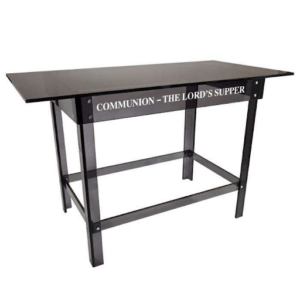
The case for acrylic
Acrylic Communion tables entered sanctuaries as stage lighting became more and more sophisticated. The main point is the transparency. When your production team is working with LED uplighting or stage washes, an acrylic table becomes part of the visual environment.
For churches that have invested very heavily in their stage design and see their worship environment as a ministry tool in itself, it matters. Light passes through the material, and the result you get is a stage that feels open and contemporary.
Acrylic is also notably lighter than hardwood. That portability is genuinely useful for churches running multiple services with different stage configurations or multi-purpose sanctuaries.
Where acrylic earns its premium Communion table label is in fabrication quality. Lower-grade options are prone to scratches and hazes over time. High-quality acrylic will not have those issues, as they bring cleaner lines and better clarity for daily use. The quality does come at a similar or higher price point as wood, and maintenance expectations may be higher than most congregations anticipate going in.
Breaking down the cost honestly
Any honest Communion table cost comparison needs to start with a simple acknowledgement: pricing in this category swings wide.
On the wood side, a mass-produced pine Communion table might run a few hundred dollars. Alternatively, a hand-built oak table with hand-carved detailing could push well past a thousand. The price point and quality gap between those two products is going to be significant.
On the acrylic side, entry-level pieces are available at comparable price points to budget wood options, but they tend to show their limitations quickly. Quality acrylic construction is genuinely high-end church furniture, priced accordingly.
Solid wood in a simpler construction typically delivers more longevity per dollar than budget-tier acrylic if your congregation is navigating real budget constraints and needs a budget Communion table that still honors the space. The wood will age gracefully. Budget acrylic, unfortunately, tends to show its age in ways that feel more like neglect than character. Quality acrylic materials last much longer and keep its beauty far longer than its budget counterparts. The decision shifts towards a vision for churches with more flexibility.
Church stage furniture trends to watch out for
Current church stage furniture trends reflect a broader tension in church design between the warm and the contemporary. Many congregations are choosing a middle ground by combining natural materials with modern silhouettes.
Full acrylic setups peaked in popularity during a period when production value was the dominant conversation in church design circles. That conversation has not disappeared, but there is a visible counter-movement. Congregations are now returning to materials that feel more grounded, more historically connected to what the table represents.
That said, acrylic is not going anywhere. For church plants and contemporary congregations, where the visual environment is central to how they express worship, it remains a very serious and legitimate option.
What actually drives the decision
Three questions tend to clarify the decision faster than any product comparison beyond material and price.
What does this table need to do physically?
Weight is going to be a real operational factor if your team needs to relocate the table frequently. In a multi-purpose room, for example, the Communion table and pulpit may need to be moved aside. Acrylic is far lighter in most cases than wood. If the Communion table is stationary, and the sanctuary is more traditional, wood may be your best choice.
What does your stage lighting look like?
If your production setup involves significant color and movement in your lighting, acrylic is going to be a better choice. Wood will integrate more naturally if your lighting is warmer and more static.
What does your congregation expect to see at the front of the room?
The table is obviously present during Communion, and Communion is one of the most significant acts of worship a congregation shares together. What that table looks like communicates something about how your church understands the sacrament.
A budget Communion table can absolutely still serve that moment well. A premium Communion table does not automatically serve it better. The material is one factor. Your church’s observance is another.

Making the right call
Wood and acrylic are not competing for the same congregation. They are serving different rooms. They are serving different aesthetics. Neither is inherently more reverent. Both can honor what happens at that table on Sunday morning.
Know your stage. Know your budget. Know what your church is trying to say.
Then choose the table that serves the people gathering around it.